ECOSOC
United Nations Economic and Social Council
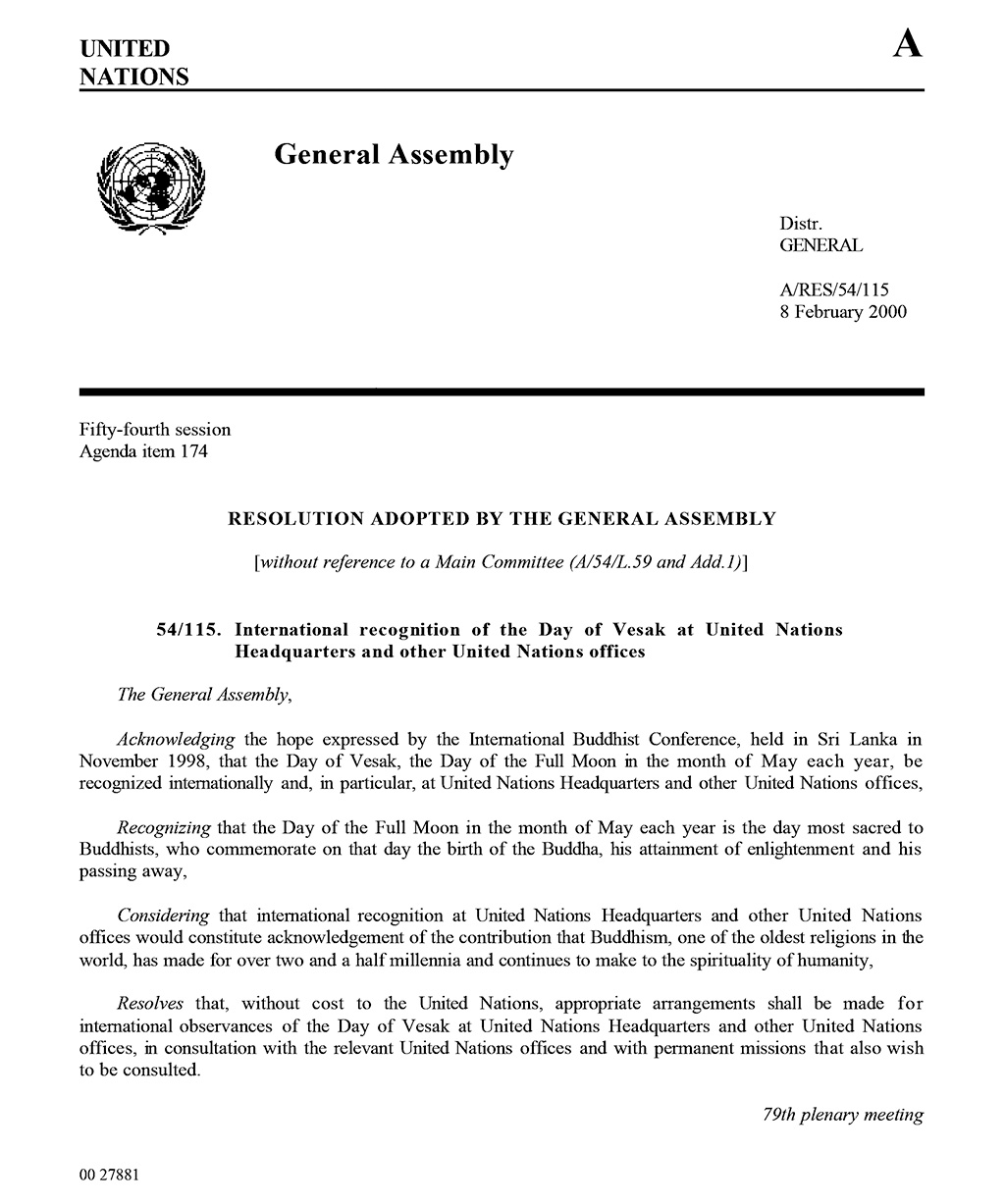
The United Nations Day of Vesak was established through a resolution passed by the UN General Assembly on December 13, 1999, during Session No. 54, Agenda item 174. This significant decision came following a proposal by 34-member state representatives to recognize Vesak Day as an international observance and to organize appropriate commemorative activities at both UN Headquarters and other United Nations offices worldwide.
In its deliberations, the General Assembly acknowledged Buddhism’s status as one of the world’s oldest religions and its profound contributions to human spirituality spanning more than 2,500 years. Based on this recognition, the Assembly resolved to incorporate Vesak Day into the international calendar of observances, establishing a formal framework for celebration across UN facilities globally.
Since the United Nations’ recognition of Vesak Day, Thailand has consistently organized celebratory activities from 2004 to the present. This nationwide observance has been jointly coordinated by the Thai Sangha, the government, and citizens across the country. The commemorations take place at multiple levels — from local community gatherings to national ceremonies — while also engaging with the international Buddhist community to honor this significant observance.
Subsequently, on April 29, 2009, Mahachulalongkornrajavidyalaya University, together with Buddhist organizations from around the world, formalized this initiative by signing an agreement establishing the ICDV. The Council’s mandate includes encouraging Buddhist organizations globally to celebrate Vesak Day — commemorating the Buddha’s birth, enlightenment, and passing away — while fostering unity among Buddhist communities worldwide. Mahachulalongkornrajavidyalaya University was designated as the location for the ICDV’s headquarters, and since its formation, the Council has served as the principal organizing body responsible for coordinating the United Nations Day of Vesak Celebrations.
Throughout its existence, the ICDV has actively collaborated with Buddhist communities across the globe to organize the United Nations Day of Vesak Celebrations. The Council has aligned its work with the UN Sustainable Development Goals (SDGs), focusing on four core missions: (1) sustainable development, (2) addressing climate change (with particular emphasis on global warming), (3) advancing education, and (4) promoting peacebuilding. The themes selected for previous UN Day of Vesak celebrations have been carefully designed to complement these missions and support the broader framework of the United Nations’ 17 Sustainable Development Goals.
The International Council for Day of Vesak (ICDV) functions as a vital bridge connecting Buddhist traditions worldwide, bringing together adherents of Mahayana, Vajrayana, and Theravada Buddhism. This platform facilitates mutual study and deeper understanding among these diverse traditions. The Council’s integrative approach has significantly enhanced Buddhism’s propagation both locally and globally, making Buddhist teachings more accessible and relevant to contemporary society. By fostering this cross-traditional dialogue, the ICDV has helped align Buddhist principles with modern ways of life, increasing their effectiveness and applicability in today’s world.
In its deliberations, the General Assembly acknowledged Buddhism’s status as one of the world’s oldest religions and its profound contributions to human spirituality spanning more than 2,500 years. Based on this recognition, the Assembly resolved to incorporate Vesak Day into the international calendar of observances, establishing a formal framework for celebration across UN facilities globally.
Since the United Nations’ recognition of Vesak Day, Thailand has consistently organized celebratory activities from 2004 to the present. This nationwide observance has been jointly coordinated by the Thai Sangha, the government, and citizens across the country. The commemorations take place at multiple levels — from local community gatherings to national ceremonies — while also engaging with the international Buddhist community to honor this significant observance.
Subsequently, on April 29, 2009, Mahachulalongkornrajavidyalaya University, together with Buddhist organizations from around the world, formalized this initiative by signing an agreement establishing the ICDV. The Council’s mandate includes encouraging Buddhist organizations globally to celebrate Vesak Day — commemorating the Buddha’s birth, enlightenment, and passing away — while fostering unity among Buddhist communities worldwide. Mahachulalongkornrajavidyalaya University was designated as the location for the ICDV’s headquarters, and since its formation, the Council has served as the principal organizing body responsible for coordinating the United Nations Day of Vesak Celebrations.
Throughout its existence, the ICDV has actively collaborated with Buddhist communities across the globe to organize the United Nations Day of Vesak Celebrations. The Council has aligned its work with the UN Sustainable Development Goals (SDGs), focusing on four core missions: (1) sustainable development, (2) addressing climate change (with particular emphasis on global warming), (3) advancing education, and (4) promoting peacebuilding. The themes selected for previous UN Day of Vesak celebrations have been carefully designed to complement these missions and support the broader framework of the United Nations’ 17 Sustainable Development Goals.
The International Council for Day of Vesak (ICDV) functions as a vital bridge connecting Buddhist traditions worldwide, bringing together adherents of Mahayana, Vajrayana, and Theravada Buddhism. This platform facilitates mutual study and deeper understanding among these diverse traditions. The Council’s integrative approach has significantly enhanced Buddhism’s propagation both locally and globally, making Buddhist teachings more accessible and relevant to contemporary society. By fostering this cross-traditional dialogue, the ICDV has helped align Buddhist principles with modern ways of life, increasing their effectiveness and applicability in today’s world.
ICDV’s Special Consultative Status with the United Nations Economic and Social Council (UN ECOSOC)