Bangkok Declaration – 19th International Vesak Day Conference
20 May 2024
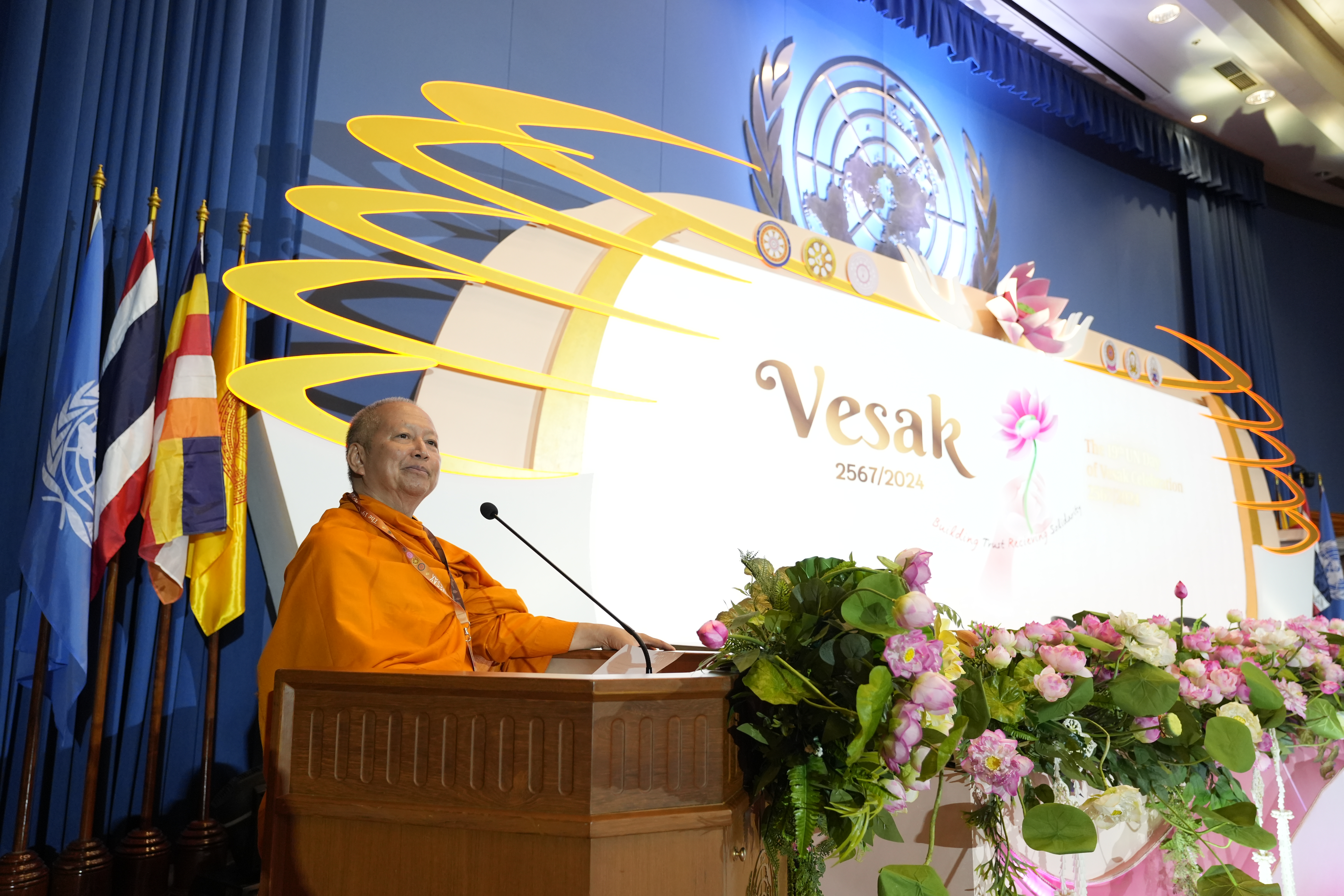

Bangkok Declaration – 19th International Vesak Day Conference
On 15 December 1999, representatives from 34 countries proposed to the United Nations General Assembly that Vesak Day, which falls on the full moon day of May, be recognized as an International Day of Observance and be celebrated at the UN Headquarters and its regional offices. The UN General Assembly adopted this resolution (54th Session, Agenda Item 174).
Thus, International Vesak Day was established in the year 2000 through the cooperation of Buddhists from all traditions in support of the UN General Assembly resolution.
We, representatives from 73 countries and regions, have gathered to celebrate the Birth, Enlightenment, and Passing Away of the Buddha from 19–20 May 2024 and to honor the 72nd Birthday Anniversary of His Majesty King Maha Vajiralongkorn, Rama X of Thailand.
This conference was jointly organized by the International Council for the Day of Vesak and Mahachulalongkornrajavidyalaya University (MCU), with support from the Government of Thailand and guidance from the Sangha Supreme Council of Thailand.
During the meetings held at MCU Wang Noi, Ayutthaya; the United Nations Conference Centre (UNCC), Bangkok; and Buddhapadipa, Nakhon Pathom, we engaged in dialogue on the theme: “Buddhist Ways for Building Trust and Harmony.” The aim was to foster understanding and collaboration among organizations and individuals across all Buddhist traditions as well as other religions.
After the conclusion of these constructive discussions, we unanimously adopted the following 12-point Declaration:
1. Blessings for His Majesty the King
Buddhist leaders from 73 countries and regions respectfully invoke the Triple Gem to bestow blessings upon His Majesty King Maha Vajiralongkorn, Rama X, on the auspicious occasion of his 72nd Birthday Anniversary, wishing him long life and well-being.
2. Appreciation for the English Translation of the Tipitaka
We commend the project to translate the 45-volume Siam Edition of the Pali Tipitaka into English, undertaken by both Thai and international scholars. Initiated by the Sangha Supreme Council and supported by the Thai Government in honor of His Majesty the King, this year marks the publication of the first volume of each of the three Pitakas, to celebrate His Majesty’s 72nd Birthday Anniversary.
3. Call for Global Trust and Harmony
Recognizing our shared goals and responsibilities, we call on citizens and governments worldwide to intensify efforts to build trust and harmony in a fragmented world, using mindfulness, empathy, and compassion as the foundation for respectful dialogue and cooperation.
4. Building Relationships Beyond Differences
Acknowledging universal suffering and the desire for happiness, we resolve to foster relationships that transcend visible cultural and ideological differences.
5. Cultivating Trust Based on Buddhist Teachings
We affirm the Buddhist principles that encourage cultivating trust within ourselves and others by shifting from competition to cooperation, promoting emotional mindfulness, effective communication, and problem-solving—ultimately contributing to global collaboration.
6. Importance of Tolerance and Mindful Dialogue
We emphasize the value of tolerance, deep listening, and mindful dialogue as essential tools for nurturing mutual respect and bridging differences across religions.
7. Commitment to Mindful Education
We pledge to strengthen and promote mindful education to ensure that younger generations develop the necessary skills and knowledge to help build a more peaceful and compassionate world. These principles are rooted in ethical conduct, mindfulness, and wisdom guided by compassion, as taught in the Four Noble Truths and the Noble Eightfold Path.
8. Applying Compassionate Mindfulness in Daily Life
We urge Buddhist communities and all societies to apply compassionate mindfulness in all aspects of life. Examples discussed include:
(a) Mindful eating practices, such as in Zen traditions, fostering awareness of interconnectedness.
(b) Compassionate mindfulness in the workplace, especially in health-related professions. (
c) Mindful education, such as the “Mindful School Program” (Satipaṭṭhāna Schools) in Sri Lanka.
9. Mindfulness in All Areas of Engagement
We agree that mindfulness should guide all activities—diplomacy, international trade, nation-building. Vietnam serves as an exemplary model of using present-centered mindfulness to overcome painful historical memories, thereby promoting healing, peace, and prosperity.
10. Mindfulness to Reduce Inequality
We declare that widespread application of mindfulness has the potential to reduce inequality and narrow health and economic gaps between the rich and the poor, making it an effective tool for achieving the United Nations Sustainable Development Goals, crucial for our collective future.
11. Mindful Action for Climate Awareness
We highlight the urgent need for mindful action in response to ongoing climate change and call on leaders to embody mindfulness, setting an example for environmental stewardship across all levels of society.
12. Announcement of Vietnam as Host of the 20th International Vesak Day
The International Council for the Day of Vesak is pleased to announce and endorse the Vietnam Buddhist Sangha as host of the 20th International Vesak Day in Ho Chi Minh City, Vietnam, 2025—the fourth time Vietnam has received this honor. We invite Buddhist leaders, scholars, and all interested individuals to join us in Vietnam for this significant event.
Bangkok Declaration – 19th International Vesak Day
Issued on 20 May 2024